
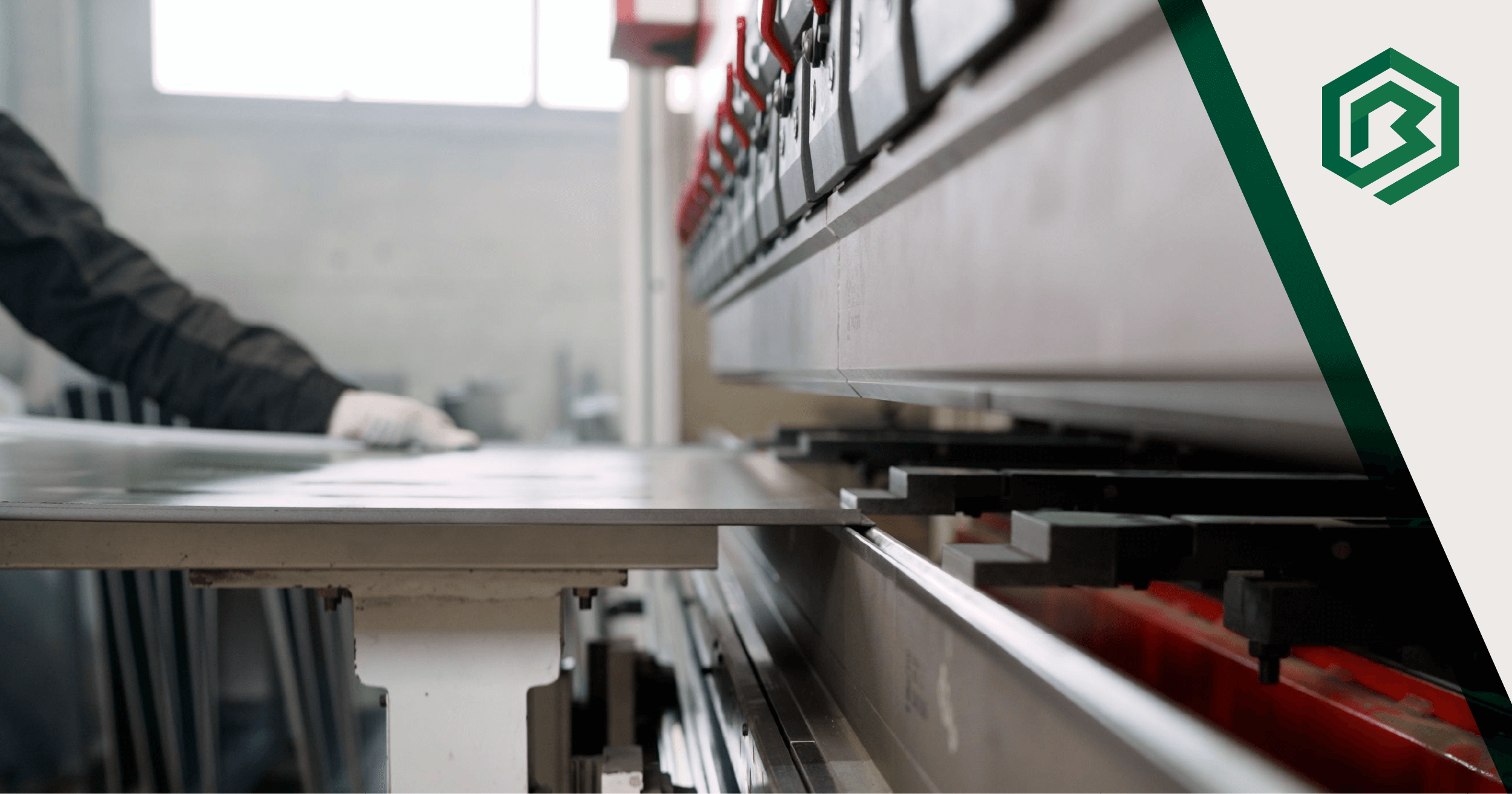
The press brake has been a cornerstone of metal fabrication for well over a century. The first brake was patented in 1882 — a manually operated machine built from cast iron and oak, known as the cornice brake, that forced clamped sheet metal into a straight-line bend through sheer labor. You can read more about its origins here.
Today's press brakes bear little resemblance to that early machine. Modern hydraulic and CNC-controlled systems bend sheet and plate metal with repeatability accuracies measured in thousandths of an inch, handle complex geometries, and process materials at a scale and speed that would have been unimaginable in the 19th century.
This guide covers how press brake forming works, what Boyd Metals' equipment can actually handle, what materials are best suited to the process, and how to determine whether it's the right fabrication method for your project.
How Press Brake Forming Works
A press brake uses a punch and die set at predetermined angles to bend metal into a specified shape or form. The punch presses the material into the die, producing a bend at a controlled angle and radius.
The Role of Tonnage
The most fundamental parameter in press brake forming is tonnage — the total force the machine can apply during a bend. Tonnage determines which material thicknesses the machine can process. Higher tonnage enables forming of thicker, harder materials; lower tonnage is suited to lighter gauge work. Matching tonnage to the job is not optional: applying the wrong tonnage can damage tooling, compromise the bend, or ruin the machine.
Bending Length and Load Limits
Bending length refers to the maximum length of sheet metal a machine can bend in a single stroke. A machine with a 14' bending length cannot process material that exceeds that dimension. Combined with tonnage, bending length determines the machine's load limit — expressed in tons per inch — which sets the outer boundary of what can safely be formed on that press. Learn more about press brake tonnage limits.
Types of Press Brakes
Modern press brakes fall into three categories. Understanding the differences helps determine which type is appropriate for a given application.
Manual Press Brakes
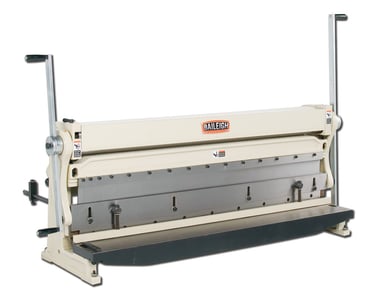
Manual press brakes — sometimes called sheet metal brakes — require the operator to adjust bending dimensions and angles manually for each operation. They are best suited to high-volume runs of consistent bend sizes and angles where setup time is not a repeated variable.
Hydraulic Press Brakes
CNC Press Brakes
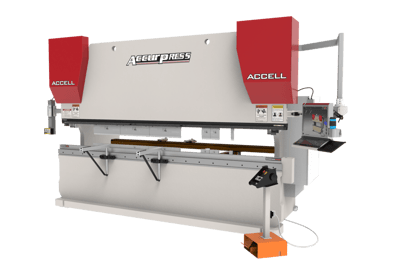
CNC press brakes provide the highest level of precision and repeatability. The operator enters parameters — bending angle, plate thickness, width, and material grade — into a controller, and the machine executes accordingly. CNC systems reduce setup time on complex parts, minimize operator error, and are well suited to jobs requiring close-tolerance forming or multi-bend sequences. Boyd Metals operates CNC hydraulic press brakes at its Oklahoma City and Joplin facilities.
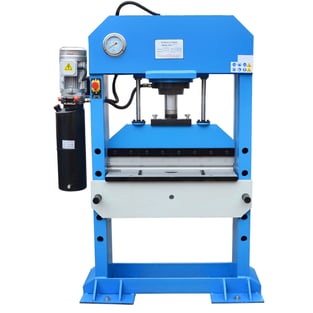
Hydraulic press brakes use two hydraulic cylinders to deliver more controlled and consistent strokes than manual systems. They are classified by ram movement: up-acting or down-acting, each with distinct advantages depending on the application and material. Learn more about the differences between up- and down-acting brakes.
Boyd Metals' Press Brake Equipment and Capabilities
Boyd operates two press brake models, each with specific features suited to different project requirements.
230-Ton Cincinnati Proform — Oklahoma City, OK
The 230-Ton Cincinnati Proform features:
- Bend Simulation Software that simulates the bending sequence and displays part, tooling, gauge, bed, and ram visualization at each step, allowing operators to verify sequence and manually adjust tool, part, and gauge positions before a single bend is made.
- A customized 16" stroke with a 14' overall bed length and 12'6" between housings.
- Hydraulics with dual pressure transducers for increased tonnage accuracy and digital encoders delivering ±0.0004" (0.01 mm) ram repeatability for close-tolerance forming.
- Dynamic Thickness Compensation (DTC), which automatically adjusts for variations in material thickness to maintain consistent air bend angles across a run.
350-Ton Accurpress Accell E — Joplin, MO
The 350-Ton Accurpress Accell E features:
- Precision Y1/Y2 synchronized closed-loop hydraulics with repeat and parallelism positional accuracies of +/-0.0004" (0.01 mm) across the length of the brake.
- Vision 3D Software for full 3D programming, bend visualization, and dynamic viewing during the forming process.
- A customized 16" Extended Throat Depth for parts requiring deeper flange lengths.
- Vision Control Elite Backgauge for tapered gauging and automatic part-gauging across 6 axes (X1/X2, R1/R2, Z1/Z2), offering greater flexibility for complex setups.
- Advanced frame integrity for precise off-center bending applications.
- Wila Hydraulic Ram Clamping compatible with American tooling.
Both machines support full 3D programming, bend visualization, and dynamic viewing during forming — capabilities that are particularly valuable when running complex part geometries or multi-step bend sequences. Learn more about Boyd Metals' press brake services.
What Materials Work Best with Press Brake Forming
Press brake forming is compatible with a wide range of metals. Boyd's material inventory includes carbon steel, stainless steel, and aluminum in sheet and plate formats, as well as other metals including brass and copper. Forming parameters vary by material — harder or higher-strength materials require more tonnage and may have tighter minimum bend radius requirements, and material thickness directly determines which machine is appropriate for a given job.
When submitting a quote or order, providing material grade, gauge or thickness, and required bend angle helps Boyd's team confirm the right equipment and setup.
When Press Brake Forming Is the Right Choice
Press brake forming is well suited to projects that require precise, repeatable bends at specific angles across sheet or plate metal, parts with complex multi-bend geometries or deep flange lengths, and close-tolerance forming where ±0.0004" repeatability is required. It is also a strong fit when 3D programming and bend simulation are needed to reduce setup risk on complex parts, or when off-center and tapered bending applications are involved.
It is particularly valuable when a project calls for fabricated components across industries — auto, aviation, agricultural, energy, military, and transportation — where dimensional accuracy and consistency directly affect downstream assembly and function.
When Another Process May Be Better
Press brake forming has limits. If your project involves cutting flat profiles rather than forming angles, laser cutting or plasma cutting is the right starting point. Projects requiring cylindrical or curved cross-sections rather than straight-line bends may be better suited to rolling. For high-volume, simple profiles, roll forming or stamping may offer better throughput economics.
In many cases, press brake forming is one step in a multi-process workflow that also includes laser cutting, plasma cutting, or sawing. Boyd's team can help determine the right process routing based on your material, thickness, and part geometry
.
Industries That Rely on Press Brake Forming
Press brake-formed components appear across a broad range of end markets. Common applications include structural brackets and frames, enclosures and housings, agricultural equipment components, transportation parts, energy sector fabrications, and military and defense components. The ability to produce precise, complex bends in a wide range of materials makes the press brake one of the most versatile tools in a metal fabricator's operation.
Work with Boyd Metals on Your Next Forming Project
Boyd Metals operates press brake equipment at its Oklahoma City, OK and Joplin, MO facilities, with material inventory and processing services available across its regional locations. Whether you're working from a completed design or still sorting out material selection and process method, Boyd's team can help you confirm the right approach, get accurate pricing, and keep your project on schedule.